March 18, 2026
·4 min read
What Idle Cash Is Actually Costing You
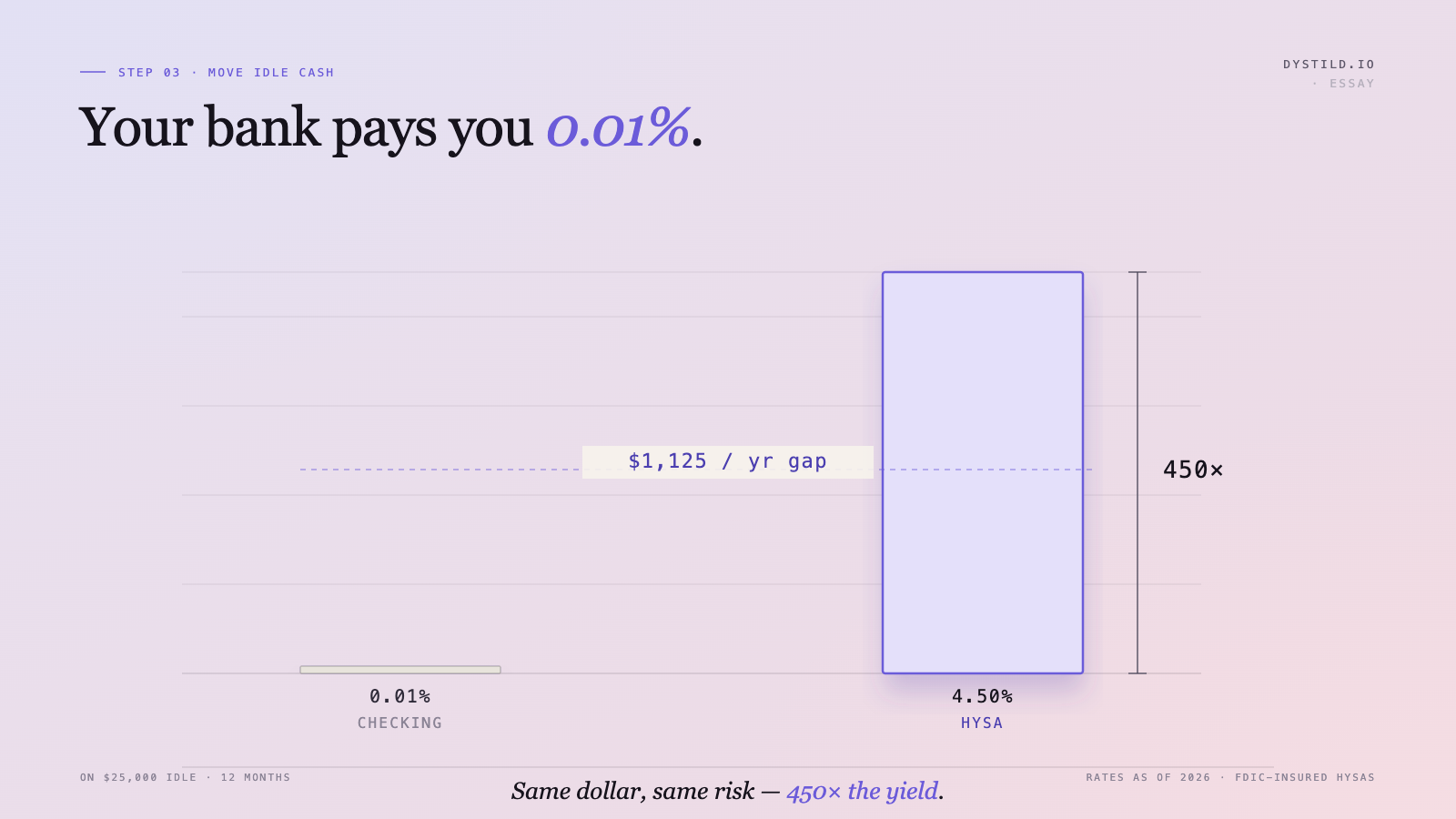
Here's a number most banks don't advertise: the average checking account in the US pays 0.01% interest. That's not a typo. On $30,000 sitting in a Chase or Bank of America checking account, you'd earn about $3 a year.
Meanwhile, high-yield savings accounts at online banks — SoFi, Marcus, Ally, Wealthfront — are paying 4.5 to 5% right now. Same FDIC insurance. Same liquidity. You can still move the money whenever you want.
The gap between those two numbers, applied to the amount most people actually have sitting around, is one of the quietest wealth-destroyers in personal finance.
The numbers people don't run
Let's say you keep $25,000 in your checking account as a combination of emergency fund, upcoming expenses, and general buffer — which is pretty normal for a household earning $80–100k.
At 0.01%, that earns you $2.50 per year.
At 4.5%, it earns you $1,125.
Over five years, assuming rates stay roughly where they are: you've left about $5,500 on the table. That's a flight, a month's rent, or — if you'd invested it instead — the start of something that compounds for the next 30 years.
The math gets worse the longer you let it sit. This isn't market risk or anything complicated. It's the cost of not moving money from one account to another.
Why most people don't do it
It's not ignorance. Most people have heard of high-yield savings accounts. The reason it doesn't happen is friction — the idea that it'll take a while, that it might be complicated, that you'll need to think about it later.
Later turns into a year. Then five years.
The other reason is psychological: checking accounts feel like the "real" account. The place where money lives. Moving money somewhere else — even temporarily, even when it's better — feels like a step, like something that requires a decision.
It doesn't. Opening a high-yield savings account online takes about 10 minutes. You link your checking account, transfer what you want to park there, and that's it. The money is still accessible in 1–2 business days. It's still FDIC insured up to $250,000. It just earns about 450 times more interest.
What to actually do
The simplest version: figure out how much cash you're holding beyond what you actually spend each month. Put that in a high-yield savings account. Keep your checking account for what it's meant for — paying bills, covering day-to-day spending.
If you have more than 6 months of expenses sitting in cash, the question starts to shift from "where should this be?" to "should some of this be invested instead?" That's a different conversation. But it starts with getting the cash you do want to hold out of a 0.01% account.
The banks aren't going to tell you to do this. They make money on the spread between what they pay you and what they earn on your deposits. Moving your money to a better account is, mildly, against their interests.
That's enough reason to do it.